The click-through rate (CTR) significantly drops off after number one and that is because people trust the person who is at the top and, quite frankly, don’t have the time to waste scrolling up and down Google.
Therefore, although there are tons of resources and tools out there to help you get to that desired top spot, there are also many common mistakes that you’ll be making unintentionally.
That’s why, in today’s article, we want to break down the top 10 biggest SEO mistakes so you can identify what you may be currently doing wrong and also things you can potentially implement to further boost your chances of ranking No. 1 on Google. Keep reading on to gain a deeper understanding!
What Are the Types of Mistakes You Can Make?
Before jumping right into the common SEO mistakes, we feel it is important that you know the two areas of your website where the issues below will occur. Within SEO, you can either make mistakes on the technical SEO (off-page and less transparent for the viewer) side of your website or the on-page (easily recognised by the viewer) part of your website.
Off-page mistakes are less likely to be seen by the reader, but Google will pick up on these mistakes and harm your rankings for that page. Whereas, on-page mistakes are not only noticeable by Google, but the reader may pick up on them too, leaving you with less chance of them interacting with your website.
10 Biggest SEO Mistakes and How to Avoid Them
Below are the top 10 biggest SEO mistakes that we see businesses making nowadays. However, rather than just listing them for you and leaving you to figure it out on your own, we’re going to break down each issue and guide you through avoiding the problem in the first place.
- Not Defining Who or Where You Want to Target
- Lack of Quality or Duplicate Content
- Only Optimising the Website For a Laptop
- Not Completing Any Keyword Research
- Keyword Stuffing
- Having a Slow Website Speed
- Not Letting Google Crawl or Index Any of Your Content
- Not Optimising Images in Any Way
- Not Building a Backlink Profile
- Not Creating Effective Meta-Data
1. Not Defining Who or Where You Want to Target
Mistake: You are not focusing on who your target audience is or whereabouts in the world your product or service is most suited to.
The consequences: It can result in unfocused SEO efforts and missed opportunities for reaching the right audience. When you fail to identify your target audience, you will risk creating content that doesn’t resonate with potential customers.
How to avoid: Before beginning your SEO strategy, you need to map out and complete some market research beforehand. Using tools such as Ahrefs and SEMrush, along with Google Analytics, you’ll be able to find whether your target audience is suited to a more local SEO campaign or whether they can be targeted nationally or even worldwide.
(A quick example:) You’re a brick-and-mortar company providing personalised wedding cakes for those in your local area and you don’t have the capabilities to deliver nationally. Therefore, targeting young and middle-aged couples in your local area will reap the best results for the SEO campaign, driving the most traffic and sales to your website and in-person store.
2. Lack of Quality or Duplicate Content
Mistake: You create low-quality content using AI or copy and paste pages with the same content. Or, if you target internationally, your UK and US pages, for example, will look the same.
The consequences: If you don’t focus on quality and are duplicating content, you will run into issues such as…
-
- Google won’t understand what page to rank where (chaotic rankings)
- A different and irrelevant page may show for the keywords you’re trying to target
- Google’s human evaluators will avoid it, and E-E-A-T guidelines won’t be met
- Search algorithms will pick up on low-quality and duplicate content, leading to low rankings
How to avoid: We advise you to build every page with care and quality. Although it may take more time, once you have high-quality pages set up, Google will recognise your efforts, and all you have to do is keep optimising over time with solid SEO practices, and you have a much higher chance of ranking No. 1.
Taking the time to read the E-E-A-T guidelines and what makes a high-quality page will also help you increase your effectiveness in the SERPs.
3. Only Optimising the Website For a Laptop
Mistake: You are creating and editing your website solely for laptop users and not checking how responsive the website is on other devices, such as a mobile phone or tablet.
The consequences: If you’re only creating the website for laptop users, you will find that mobile and tablet users will bounce immediately after going through your website. If it isn’t aesthetically pleasing, easy to use, or easy to navigate, no one is going to purchase or look through your website.
How to avoid: As you build your website or a page you’re creating, you should always check how it looks on a phone or laptop before publishing the content to your site. This way, you will ensure that no matter what device your target audience is using, they’ll have a great user experience and be more willing to act on your offerings.
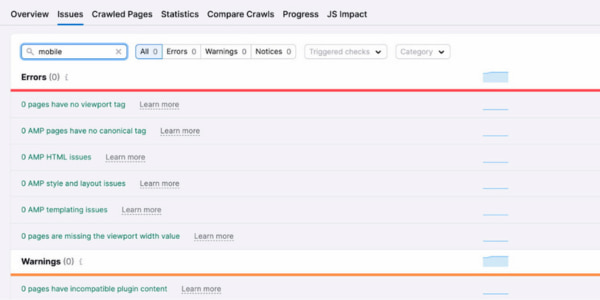
(Tip →) You can also use tools such as Site Audit on SEMrush to identify technical issues on a mobile device if you cannot see them visibly yourself. See below to see how:
4. Not Completing Any Keyword Research
Mistake: You are most likely creating content that you feel is necessary for your viewers, rather than researching the keywords in your industry to base your content around. You create content based on feeling rather than cold, hard data.
The consequences: Your content will never be seen organically on Google. In fact, a study by Ahrefs shows that 90.63% of all pages created on Google never get any organic search traffic!
How to avoid: Using tools such as the Keyword Magic Tool in SEMrush, or Keyword Explorer in Ahrefs will allow you to search for terms in your industry and create pages around keywords that are actually getting search volume on Google. Make sure you choose keywords that are high in volume and as low as possible in keyword difficulty (how hard it is to rank for that keyword).
5. Keyword Stuffing
Mistake: You find the keywords that are relevant to helping you rank on Google but are overusing them or “stuffing” them within your content.
The consequences: Your content will look unnatural and unprofessional, and people will be able to tell you’re trying to over-optimise your content for SEO performance, leading them to not trust and leave your website.
How to avoid: When trying to implement keywords within your content, try to implement them naturally. If you read your content and it doesn’t look natural, write it again without the keyword and try to fit that keyword into your content elsewhere. Or, if a keyword is completely irrelevant, don’t include it at all.
6. Having a Slow Website Speed
Mistake: Slow website speed comes from a multitude of factors: high traffic volume, too many images and plugins, outdated code, server performance issues, lack of caching, and many more that you may not be aware of.
The consequences: Slow website speed creates a frustrating experience for users, and if it happens over and over, the chances of them bouncing from your website because of it are very high. Google also takes into consideration your site speed as a ranking factor, so it can harm your rankings if your website loads slowly.
How to avoid: When you audit your website, it will show unique errors affecting its speed and all you need to do is act on them. For example, you may need to optimise and compress images, change your server location, and reduce the number of redirects on your website. Every website has unique issues, but seeking a professional in this realm may be handy.
7. Not Letting Google Crawl or Index Any of Your Content
Mistake: Google can’t see or crawl any of your content, and your content isn’t indexed on Google.
The consequences: If Google can’t see or index your content, you won’t be able to rank at all on Google, never mind in the top spot.
How to avoid: To allow Google to crawl your content, you will need to allow Googlebot to crawl your site, as it may be blocked from doing so. You need to do this by going to robots.txt (yourdomain.com/robots.txt) and removing the piece of code below (if it’s showing).
User-agent: Googlebot Disallow: / User-agent: * Disallow: /
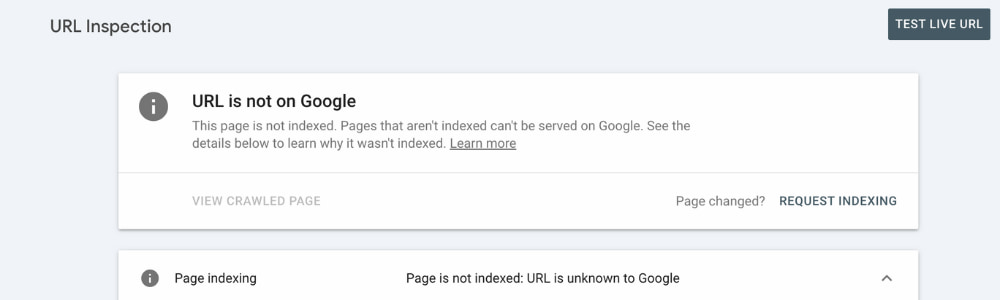
To index your content on Google, you need to use Google Search Console, set that up and then index it by pasting the URL you want to show on Google into the URL Inspection tool and pressing the request indexing button, as shown below.
8. Not Optimising Images in Any Way
Mistake: You are adding images to your website without making any changes to them before placing them on your page.
The consequences: If you don’t resize your image, download the image at below 100KB, or add any alt text, this can affect your SEO performance significantly.
Images that aren’t sized correctly are poor for the user experience; images with too much storage space can cause your website to load slowly; and no alt text limits the accessibility of your website, all affecting your SEO performance.
How to avoid: Make sure to use resizing tools such as Canva or Squoosh, and ensure that the downloaded image is below 100KB. Also, when adding your image to your site, there will be a section where you add alt text (a section describing what the image is for the visually impaired).
9. Not Building a Backlink Profile
Mistake: You’re not building enough backlinks to the key pages you want to rank for.
The consequences: If a page is an integral part of your website and you want more people to see it, backlinks to it are vital. If you use tools to look at pages in your industry ranking well, they most likely have lots of backlinks to that page from high-quality websites, meaning you will not stand a chance against their page for your relevant search terms.
How to avoid: If you’ve decided that a page is important to you and you want it to rank No. 1 on Google, you must start building backlinks from it right away. In this case, you will need to begin reaching out to relevant and high-quality websites that would be willing and interested in linking to your content, so you can begin building authority on that page.
10. Not Creating Effective Meta-Data
Mistake: Often, when you create a page, you may just be creating the content of the page without looking at the SEO meta title and meta description.
The consequences: If you don’t have effective SEO title tags and meta description, Google won’t be provided with any context of what the page is about and other details such as the source, type of page it is, who owns it, and relationships to other data sets, making it difficult for them to rank you for anything related to the keywords you want to target.
How to avoid: When creating your page, no matter the CMS, it will provide you with an SEO meta title and meta description. From here, you need to make sure that, first, the meta title is the relevant title of the page, followed by your brand and the meta description includes the target keyword within it.
Another important metric is that your meta title should be between 50-60 characters and your meta description should be between 145-155 characters for Google’s best practices.
Don’t Let Mistakes Stop You From Starting Your SEO Strategy
Although there are an unlimited number of mistakes you can make with SEO, the worst mistake you can make is not starting at all. Not all practices have to be perfect at the start and you can always optimise your site over time to make it more SEO-friendly, but creating a website with none of these in mind will get you in trouble.
If you’re an ambitious business owner and understand the power of digital marketing, the No. 1 position on Google, and the success it can give you, from more website visits to more brand awareness and more sales, then it may be time to get a free SEO audit of your own to see what you can improve on.
]]>Part of becoming as successful as you can is branching out, becoming nationally recognised, rather than just locally, and then finally reaching the international stage where your products and services can shine abroad.
Although international SEO can get you to that level, it isn’t as simple as carrying out the same strategy as you do locally, as culture, lifestyle differences, market changes, and many more factors impact worldwide decisions.
However, if you feel as though your business is to be recognised internationally, fear not. Today, we will be providing you with the ultimate guide to creating a killer strategy in order to succeed internationally on Google using SEO. Let’s get into it!
What is International SEO?
International SEO, also known as global SEO, is the process of optimising your website to increase your visibility and rankings in search engine results pages (SERPs) for users in different countries and languages.
In a more practical sense, as a native English speaker from the UK, you may at first think that because the US and almost every country in the world can speak parts of English, they will react the same to your website, information, and products/services and this couldn’t be further from the truth.
The point of international SEO is to obviously make sure your language and regions are visible but to also send indications to Google and the search engines that you can effectively reach and provide help for people within that country or region.
This is not a straightforward process, as every business has its own quirks and a different market to enter, but there are best practices that every business that needs international SEO should consider, which we’ll run through in detail later in this post.
Who is International SEO For?
As for who international SEO is for, there is no right or wrong answer here, as everyone could do it if they wanted to. However, if you can only offer your products or services locally or internationally at the moment, it won’t be time for you to move into the international market.
If you’re an eCommerce company or online-service-based business that can provide your products and services internationally, then an international SEO strategy will be a powerful marketing tool in order to gain visibility and notoriety globally, if performed correctly.
Therefore, if you feel as though you’re prepared to align multiple individual strategies for each country and begin selling worldwide to make substantial profits, then international SEO could be for you.
What Are the Main International SEO Best Practices?
Although every international SEO strategy looks different for each company, some core best practices should always be followed within everyone’s international marketing efforts:
- Define your international market
- Look at the languages spoken in each region
- Note the language habits in each country
- Complete keyword research in each region
- Build a backlink profile for each region
1. Define Your International Market
As a company, you may know what countries you want to target, but it is always worth looking at the parts of each country that may be worth targeting more frequently. There may be a specific region that highly demands your product or service, so by using SEO tools such as SEMrush or Ahrefs, you can find out what countries and regions are suited to your offerings.
2. Look at the Languages Spoken in Each Country
Although this may sound like a given, there are many countries where there are two (or more) primary languages. Therefore, you have to consider providing content in different languages in the same country, so ensuring that you check the primary languages is vital before implementing an international SEO in a specific country.
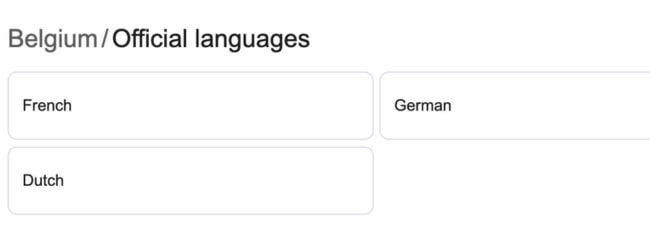
A quick example: As you can see from the illustration below, Belgium has three official languages, so if you were to target Belgium, you would have to target all three languages to obtain the best results.
3. Note the Language Habits in Each Country
This is where you have to take the initiative and understand that other countries and regions are going to have different slang and keyword habits they type into Google to get the results they want. For example, in England, you can probably recall the last time you typed something in Google that had British-related slang intertwined with it.
Although it will be a long-winded process to understand the regions you want to target, if you can begin to get a feel for how people express themselves in different languages, you’ll be miles ahead of companies in your niche trying to target them internationally.
4. Complete Keyword Research in Each Region
This carries over from the last point, but if you carry out keyword research in each country and region you target, you will find that what gets lots of search volume in one country may not in another country. Therefore, building your pages optimised on keywords that, one, are relevant to your niche, and two, get a good amount of traffic in your country, is paramount.
Using SEO tools such as SEMrush, Ahrefs and then searching Google.X for the region you want to target will be the most effective way to complete thorough keyword research.
5. Build a Backlink Profile For Each Region
Original, quality, and useful content that is responsive on multiple devices and targets relevant and worthy keyword terms is the key to creating a presence in multiple countries.
However, suppose you do not have E-E-A-T (experience, expertise, authoritativeness, and trustworthiness) in place with a solid backlink profile in each region. In that case, you won’t be as successful on the SERPs as you’d like to be. Therefore, planning how you’re going to get high-quality backlinks from the countries you’re trying to target needs to be a priority.
Benefits of Using an International SEO Strategy
Becoming internationally recognised by your target audience isn’t an easy task by any means, and it takes time, patience and a killer SEO strategy to get there. However, when you start seeing results come in, here are some benefits you can expect to notice:
- You can tap into more diverse markets, reaching more potential customers worldwide
- As you rank higher in different countries, your overall organic traffic will skyrocket
- It will boost your credibility by appearing in local searches
- User experience will be massively improved
- You can create a deep cultural connection with many countries/regions
- You will always have a better chance of raising awareness of your brand among new audiences
- You’re not limited to local or national markets
- You can establish a solid international presence for sustained business growth
What Are the Biggest Challenges When It Comes to International SEO?
On the flip side, there are always downsides to any strategy you put in place, and often there are many roadblocks that prevent businesses reaching their full potential globally. Here are some of the most common challenges businesses face when it comes to international SEO:
- Creating content for multiple languages and cultures
- Having a solid link-building plan in place for international reach
- Duplicate content for the same page in a different language
- The increased role of communication could become overwhelming
- Potential slow growth at first
Yes, we get it. They are rather big challenges and potentially time-consuming, but if you’re a business owner who is willing to work hard in unison with specialists to go all in on international SEO, step by step, you will begin to build a solid base for your international SEO strategy.
Patience and dedication are definitely required when building an international SEO infrastructure.
How to Succeed With an International SEO Strategy
Of course, we could get seriously technical within this section of the blog, but to break it down simply, to succeed with an international SEO strategy, you need a great content strategy and technical SEO fundamentals.
1: Content Strategy
Firrstly, with your content strategy, you will need to:
- Define Your Target Market: You need to create personas for each country you aim to target using tools like Google Analytics, etc., to understand trends and preferences.
- Look at Your Competition: You need to look at the organic competition in your target markets to understand challenges and opportunities.
- Are You Going to Hire?: With a project this big, it may be worth looking at hiring an international SEO agency to help speed up and improve your results.
- Do Your Keyword Research: As we said earlier, completing keyword research specific for each country will make sure your content aligns with local search behaviours and language nuances.
- Create Localised Content: If you create original content in the native language, considering cultural differences and preferences, you will see incredible results.
2: Technical SEO Strategy
Secondly, with your technical SEO strategy (once understood and implemented), you must:
- Choosing the right international domain and URL structure: Whether it’s ccTLDs (country code top-level domains), subdirectories, subdomains, gTLDs (generic top-level domains), or parameters, it must align with your goals.
- Make sure your content actually qualifies: This involves thoroughly verifying all top-level domains (TLDs), translations, and content elements to guarantee they meet local standards. Also, remember to implement the rel=”noopener” target=”_blank” hreflang tag. If not, it won’t show the geographical area and language of the page.
Other International SEO FAQs:
Oftentimes, we have a series of frequently asked questions when we speak to other business owners about international SEO. Here are some of the most common queries we deal with:
What is International SEO vs Local SEO?
In short, the main difference between international and local SEO is that for international SEO, you’re targeting a country, or multiple countries at once. Whereas, local SEO, you’re only targeting your local area. For example, if your business is in Liverpool, you will target the people of Liverpool and surrounding areas.
| International SEO | Local SEO |
|---|---|
| The website is made to target multiple languages, cultures, and markets worldwide. | Your website is built around targeting people in your local area who reside nearby. |
| Suitable for larger businesses that feel as though they can cater to a wider audience and provide products/services internationally. | Suitable for businesses operating in smaller markets (upcoming or flourishing businesses in your area). |
| You will be targeting keywords in a global market, for many different terms, as searches will differ in each country for your product/services. | Your content will be tailored to local-specific keywords, including the names of towns or cities nearby, along with the products/services you provide. |
How Much Does International SEO Cost?
In regards to how much international SEO costs, there is no exact figure on how much you’re going to be charged by every SEO company, freelancer, or in-house team. However, on average, it seems that you will be charged anywhere from £850 to £6500 a month, depending on the size of your project/website, the niche of your business, and where you intend to target.
]]>Due to remote work taking over, even some overseas SEO ‘experts’ are now becoming more renowned and used by UK companies looking to go to the next level.
Now, although this may seem overwhelming due to the array of options you have at your fingertips, there are ways you can break it down so you can choose the best SEO provider for you.
In this post, we’re going to outline the cost of SEO in the UK, the types of providers you can receive SEO services from, what to expect from them, and the common pricing models that they will use.
This is all so you can make the best decision possible for you when it comes to choosing the best service for you and your business to meet your goals, so read along to understand more.
As you may or may not know already, we are an SEO agency ourselves, but we’re going to try and cover this topic in a way that fairly and clearly outlines all the pricing models, allowing you to make a decision for yourself on what is best for your business in the UK.
The Different Types of SEO Providers You Can Choose From
The cost of SEO in the UK has many different factors that affect it, which we’ll cover more and more throughout this article, but understanding what types of SEOs you’ll be dealing with will first help you understand what may suit your company more, helping you to delve into the specialist costs of a particular provider.
The most common types of SEO providers in 2024 are:
- SEO agencies
- In-house teams
- Freelancers
SEO Agencies
When you work with an SEO agency (like us here at Quirky Digital), you can expect to receive expert advice, structure, and a plan of how they can run your SEO campaign to reap the greatest results.
Through detailed discussions, looking at goals you want to achieve, and planning out how this is going to happen, an SEO agency can boost your online presence and results via Google’s search engine using various SEO techniques.
In-House Teams
This approach is more suited to a large company with a great budget to spend on improving digital marketing, as in-house teams consist of you bringing in your own specialist SEO team into your offices to help run your campaign.
This approach is for those who can afford to have staff trained in-house, paying for SEO training and hiring staff members to carry out SEO tasks daily, which can be majorly beneficial if you have the funds.
Freelancers
Possibly the most affordable option on this list is freelancers who can carry out SEO tasks whenever you require them to.
Therefore, if you want to hire a freelancer to improve certain aspects of your SEO strategy for a few weeks or months at a time, this is feasible with freelance workers.
What Do You Receive When You Pay For SEO in the UK?
Although SEO (search engine optimisation) sounds simple sometimes and you hear phrases such as “we’ll rank you higher on Google” or “we’ll boost your online presence,” it is not as simple as pressing a few buttons and making a few amendments, and then you’ll stay on top of Google forever.
No, SEO is an ongoing, ever-changing process with lots of strategies and processes behind it.
To give you an example of some of the main aspects of SEO, here are some of the areas of focus that your SEO provider will improve when you work with them:
- SEO audits
- Link-building
- Creating high-quality content
- Keyword research
- Site speed
- Technical SEO
- Using tools & analytics
- Researching target audience
- User intent
These are only a select few of some of the main areas that SEO providers will focus on, and within these areas, there is an array of strategies to improve these ranking factors – meaning there should always be ongoing best practices being taken within your SEO strategy.
The Different SEO Pricing Structures in the UK
Now that you know who can complete SEO work for you and what it can entail on a basic level (you’ll learn more about what you receive when you speak to the SEO provider directly), there are only a few different pricing structures that the SEO professionals can offer – here is what you can expect when speaking to different providers:
- Hourly consultation
- Monthly retainer
- Performance-based
- Price per project
- Per product
Hourly Consultation
Starting with one of the most common pricing structures, hourly SEO consultations. This structure can be useful for:
-
- Small businesses who are not ready to commit to long-term contracts in SEO
- Companies that want to address specific issues quickly
- Those with fluctuating needs, which allow flexible usage based on varying SEO requirements over time
- Those with budget constraints want complete control over when they’re paying for SEO services.
Although these benefits sound great on paper, with your control and budget being catered for, SEO is one of those projects that works well long-term and if you’re only paying attention to it at certain times throughout the year, you’re never going to give your business the best potential to grow.
Monthly Retainer
Next, we have a monthly retainer, which is what most digital marketing agencies and freelancers will offer their clients, and for good reason.
This can be great for a company that wants:
- To stay consistent with their SEO efforts, giving them the best chance of long-term success
- It allows the SEO professional to get a deeper understanding of what your company needs to succeed online
- It allows the entire SEO campaign to be worked on frequently, with all aspects of SEO being covered
- Those in a competitive niche or market trying to stand out online
- Those who value long-term growth
This pricing structure allows you to reap consistent efforts within an SEO campaign, which is what you should be aiming for, but always ensure you speak to them about the terms and contract length, along with their tailored price so you know what you’re in for.
Performance-Based
This SEO package prides itself on an SEO provider only being paid when they achieve a certain result for their client.
For example, you agree on a price to pay once they get your core landing page to the first page on Google. This model has many benefits, such as not paying until you’ve received what you ask for, but can also be difficult to manage and trust plays a big part in this.
Per Project
The next pricing structure is per project, which is essentially where you pay the SEO provider a flat fee to carry out certain SEO tasks within your website for a set period of time. You and the SEO specialist should decide what the time period is and what the correct flat fee is for that project based on what you want to achieve.
Per Product
The per-product model can be an effective pricing structure for those looking to improve on only certain SEO tasks, such as content creation.
This structure allows you to pay someone for a certain amount of words per month, for example. Or, you pay an SEO provider a certain amount for them to improve your link-building strategy, and the list goes on.
This can be excellent if you’re struggling in one area and really want to hone in on it, but SEO, in our opinion, should be a continuous process that covers all the bases of SEO.
Other Factors Determining the Overall Price of SEO in the UK
Deciding how much SEO costs in the UK is not as simple as offering a ballpark figure. There are many other complexities that determine the overall price of SEO in the UK. Here is what we know to determine what that price can be in the range of:
Locations You Want to Reach
As a business owner, you should have a pretty good idea of the places you want to target, where your target audience is based, and how you’re best positioned to reach them. Therefore, with SEO pricing, the provider first needs to know…
Are You Targeting Locally, Nationally, or Internationally Through eCommerce?
If you’re a smaller business only targeting local customers, whether this be e-commerce, brick-and-mortar, or a service-based company, the price you’re going to pay compared to that of a large enterprise targeting customers all over the world with an already established brand name is going to be miles apart.
However, it still should be your decision on what you want your target audience to be, but teaming up with SEO professionals may help you determine what you’re business model suits in terms of local, national, or e-commerce SEO services.
What are the Average Costs of SEO in the UK?
Now that you have all the information, and understand clearly all the factors affecting the prices, it is never going to be set in stone what you’re going to pay for SEO in the UK.
However, we can give you some accurate numbers to give you an idea of what to expect:
| Size of Business | Average Price of SEO (Monthly) |
|---|---|
| Solo entrepreneur or Local business with a small budget to spend on marketing | £299 – £1,000 |
| The average SME with a decent budget to spend on marketing | £1,200 – £6,000 |
| A large enterprise that is already well-known and is looking to further enhance its online presence (with a huge budget to spend on marketing) | £6,000 – £10,000+ |
A quick reminder – the price of SEO in the UK will always vary depending on your business.
However, if you’re a small business or entrepreneur, you can expect to pay between £299 and £1,000 a month; if you’re an SME, you can expect to pay between £1,200 – £6,000 a month; and if you’re a large enterprise, you can expect to pay anywhere from £6,000 onwards for monthly SEO services.
Where Do You Go From Here?
Now that you know there is a variance in what you can expect to pay depending on who you go to and your own personal business requirements, it is definitely worth speaking to multiple trustworthy SEO agencies and freelancers to see what fits you best.
Sometimes, you will find that a company or a specific person will feel right – regardless of the price.
However, you should always look for someone with expertise, who has produced incredible results before and aligns with your business’s goals to help you achieve your mission and vision.
If you want to speak to us about your vision and potentially look at using SEO as a digital marketing strategy to boost your online visibility, we can provide you with a free SEO audit, to see what your company needs to expand to the next level. We look forward to speaking with you.
]]>No matter what industry you’re in and the content you produce, it is being judged and assessed by Google in some way or another, but if there’s one thing that they want, it’s to rank the most valuable, trustworthy, and relevant information at the top of the search results.
That’s where YMYL comes in, and you begin to see that the varying types of information that you’re taking in need to be presented by the most trustworthy source. Here, we take a deeper look at what you should know about YMYL in SEO for your benefit moving forward.
What is YMYL?
In regards to YMYL, this is an acronym that stands for “Your Money Your Life”. This saying within the SEO industry refers to the content you see on Google that can have a huge impact on a person’s money or their life.
YMYL is potentially the most important content on the SERPs, as it can help people make or dismiss massive decisions within their day-to-day. Google themselves have stated, “We have very high page quality rating standards for YMYL pages because low-quality YMYL pages could potentially negatively impact a person’s happiness, health, financial stability, or safety.”
This proves how seriously the human evaluators at Google take this content when looking at each individual page, along with what message it represents, whether it’s true, and whether the information provided can help a person make the correct decision. This type of information can save someone’s life, so it has to be monitored closely and regularly.
The Different Types of YMYL on Google
When you look closer at the different types of YMYL content on Google, it may surprise you that more industries fit into this category than you first thought.
Although Google themselves haven’t given us the blueprint for the exact industry or genre of content that qualifies as a YMYL website, we can certainly make calculated assumptions. However, these are the topics that we would consider to be under YMYL scrutiny:
- News and current events
- Health and safety and medical advice
- Finance
- Civics, government, and law
- Shopping
- Groups of people
- Healthcare and rehabilitation
As we stand today, these are the topics that we believe to be most aligned with Google’s statement. They could all impact a person’s happiness, health, financial stability, or safety, whether that be just one of them or all at once; thus, they have to be more closely looked at by Google’s page quality rating standards.
Why Does YMYL Matter in SEO?
So, if you can take anything from this, it would be that YMYL pages are significantly more important than most of the pages we see today on Google. Therefore, if you’re either an SEO expert with a team of content writers or a YMYL business yourself, you have to be sure what you’re writing is true, high-quality, and trustworthy information for the consumer.
Google is essentially trying to keep the user safe from seeing any content that can mislead or harm users. Let’s say you’re a company providing this type of information and are potentially misleading or harming your readers. You’re then going to be damaging your trust and reputation as a business, ultimately leading to no one trusting your business for serious advice.
Although YMYL isn’t directly a ranking factor for Google’s rankings, if they see that you’re not following these guidelines, it will never have a good impact on your rankings, as they will know you’re not providing high-quality content.
You should always prioritise quality YMYL information, and not even just for SEO, but just for your readers because they deserve to get access to trustworthy information, as it can affect their financial well-being and health, and as a company, you need to have the integrity to do this.
How Can You Use E-E-A-T to Improve Your YMYL Content?
E-E-A-T is another acronym that stands for “Experience, Expertise, Authoritativeness, and Trustworthiness”. YMYL and E-E-A-T are two of the most important considerations that Google human evaluators use in the page quality rating standards.
E-E-A-T is essentially a set of guidelines for your pages that Google evaluators assess by looking at the experience, expertise, authoritativeness, and trustworthiness of the company writing them.
Therefore, if you can combine a high-quality piece of content with the E-E-A-T, you’ll be highly regarded. However, how can you actually implement E-E-A-T within your YMYL content to reap the best results from Google’s quality rater guidelines? Let’s take a look:
Hire Expert Content Writers For SEO-Based Performance
As business owners, you are total experts in your field of work and your industry expertise and knowledge will be extremely valuable.
However, using expert content writers who have had experience structuring, planning, and executing valuable information for YMYL and E-E-A-T will give your business a much higher chance of success on Google when you collaborate both your efforts together.
Vet and Cite Your Sources
When searching for information that is going to be placed within your content, you need to be thoroughly confident that what you’re providing is true and reputable.
The best way to do this is by choosing the most renowned websites to source your information from, along with double and triple-checking your facts before publishing and adding external citation links so your audience can always fact-check you.
Make Sure the Content is Written With Value
This point ties in with hiring expert content writers who have worked in multiple YMYL industries, as using a professional tone for YMYL content is more suitable sometimes, not all the time, as you may think.
As the SQ guidelines specify, even informal forum type content can be suitable for YMYL topics as a form of ‘everyday expertise’ (this was actually one of the driving factors in adding the extra E for experience to EAT). The main takeaway from this is to provide value, no matter the tone of voice.
Clear Up Any Misconceptions
There are always two sides to every argument or point made, so clearing up the other sides of the story and presenting why your evidence is clear and accurate is paramount. Striving for clarity, accuracy, and sincerity should be carried out in every piece of writing.
YMYL in Summary
Ideally, overall, if you’re in YMYL sectors, you should be trying to create content that aligns with E-E-A-T principles, as becoming a trustworthy figure in your niche can not only boost your search engine rankings, but you will also find that you’ll be receiving a lot more business from your target audience.
If you want a team of SEO experts with dedicated content writers who have worked with ‘Your Money Your Life’ content for years, reach out to us today by calling 0151 662 0152 or filling out the ‘Get a Quote’ form in the top right-hand corner of our website, and we’ll see if we’re the right fit to work together. Take your YMYL content to the next level with Quirky Digital by getting started with your free SEO audit from us today.
]]>The brains behind Google are never satisfied and always want to add additional quirks, but this can cause SEO experts and businesses trying to implement SEO some trouble if they’re not ready to adapt.
Recently, Google updated E-A-T to E-E-A-T Guidelines, which have been a huge part of the Search Quality Rater Guidelines, and the first-hand experience of a company is becoming more important than ever.
To see what the updated guidelines are and their importance in SEO for you moving forward, that’s what we’ll discuss in this article, so keep reading to learn more!
What Are Google E-E-A-T Guidelines?
In regards to E-E-A-T, this is an acronym that stands for Experience, Expertise, Authoritativeness, and Trustworthiness. Even though E-E-A-T isn’t a direct search ranking factor, if you follow these guidelines and have all the guidelines provided, you’re sure to see better performance as a website.
E-E-A-T is reviewed by Google’s quality raters (human evaluators who assess the quality of web pages and search results), so if you’re a well-known company that is trusted by many with years behind you, you’ll meet these guidelines nicely.
Why is E-E-A-T Important For SEO?
As you look closer at each individual section of E-E-A-T, you can see how having all of these in abundance can create a safety net for the audience.
For example, let’s say you were purchasing a product or service from a business that was experienced, had a high level of expertise, was authoritative within their niche, and was trustworthy – of course, you’d want to buy from that company because you feel safe.
However, no matter if you have experience, expertise, and authoritativeness, you can still get away with not being a trustworthy company in some cases, and that’s why Google says “untrustworthy pages have low E-E-A-T no matter how Experienced, Expert, or Authoritative they may seem.”
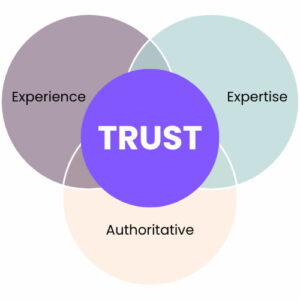
Yet, if you look at E-E-A-T as a whole, it is important for SEO because Google is giving you direct guidelines on what they believe to be high-quality content, and providing users with the most relevant and valuable information.
Therefore, if you uphold Google’s standards and are abiding by their E-E-A-T standards, (regardless of the type of content you’re producing), you’re more than likely on your way to becoming a top brand within your industry.
To make sure you align yourself with Google’s rater guidelines (E-E-A-T), check this out to see their informative blog on the latest updates!
How Google’s Human Quality Evaluators Look at Your E-E-A-T
Google search is an ever-changing platform, as there are always new processes that seem to rank content higher than the rest. However, with SQ rater judgements, these real people evaluating the SERPs daily are always testing for usefulness.
This essentially means that their judgements from the rigorous evaluation process will eventually turn into algorithm updates and drive the new changes within Google’s core updates.
When you look at what Google’s human quality evaluators look for in your web pages on your website to determine whether you abide by their guidelines, there are specific measures that they have to take in order to qualify your page.
To break it down as easily as possible for you, we’re going to show you what they see as the different types of low-quality pages and also the different types of high-quality pages, so you can best prepare yourself when creating your content, images, and SEO structure. Here is what to look out for:
Types of Lowest-Quality Pages
Within the E-E-A-T guidelines, here is what Google is looking out for when reviewing the lowest standard of page, as stated on Google’s search quality evaluator guidelines PDF:
- “Pages that encourage, depict, incite or directly cause physical, mental, emotional or financial harm to self or other individuals
- Pages that promote, condone, or incite violence or hatred against a Specified Group of people
- Pages that misinform people in a way that could cause harm
- Pages or websites that are deceptive or have untrustworthy characteristics
- Pages with characteristics of webspam”.
Types of Highest-Quality Pages
Now that you have a better understanding of what a low-quality page looks like, here are some of the characteristics of high-quality pages that you can use within your site:
- “High-quality pages have a beneficial purpose
- High-quality pages are not expected to cause harm
- A page on any topic or any type of website may qualify for High
- High-quality pages have titles that summarise the page
- High-quality pages have adequate information about the website and content creator for the purpose of the page. For stores or websites that process financial transactions, examine the customer service information
- MC created with a high level of effort, originality, talent, or skill such that the page achieves its purpose well.
- Positive reputation of the website for the topic of the page. Positive reputation of the content creator for the topic of the MC.
- High level of E-E-A-T for the purpose of the page”.
[Worth mentioning] —> All of the previous information under ‘Types of Low-Quality Pages’ and ‘Types of High-Quality Pages’ is provided by Google itself, so taking away from it what you will, will allow you to create and optimise current pages to meet a higher quality of E-E-A-T.
Examples of Our Google E-E-A-T Audits For SEO Performance
At Quirky Digital, we do not only just audit our clients’ websites for SEO performance and search engine rankings, but we also carry out E-E-A-T audits too, in order to maximise their relationship with Google’s guidelines.
To see what details go into it, we’re going to give you a couple of teasers from our E-E-A-T checklist that you can begin using today to gain more credibility for your business:
Teaser One: NAP (Name, Address, and Phone Number)
When looking at our clients’ websites, if they don’t have a clear name, address, and phone number, this can seriously harm how potential customers interact with your site.
If they can’t see where to visit, who to contact, or the name of your company, it’s going to be extremely difficult to work with them, as they won’t be a trusted source of information.
Teaser Two: About Us Page
An ‘About Us’ page is crucial as part of our E-E-A-T checklist, as this allows potential customers/clients to read through your company’s goals, staff, objectives, mission, vision, and many more. When they can connect with you, you’re more likely to receive more business so this is vital for SEO performance.
Find a Snippet of Our E-E-A-T Checklist
If you found the above two teasers useful and want to find some more key parts of our E-E-A-T checklist so you can begin using it for your own business, check it out here!.
Take control of your website today so Google can see you as an experienced, expert, authoritative, and trustworthy business.
]]>One of the most prominent ways to boost your brand awareness is by implementing a killer SEO strategy to improve your visibility on Google. Once you start ranking for relevant search terms in your line of work, you will start to see business coming in like there’s no tomorrow.
A topic that is talked about heavily in the SEO realm at the moment is the use of NLP SEO and the importance of the techniques used for your search results in the short and long term.
To see how NLP techniques can be used in your favour and whether they’re truly crucial for your search rankings and relevant search queries, we’ll break down exactly what it is and how to utilise it to squeeze the most benefits out of it as possible. Carry on reading to learn more!
What is Natural Language Processing (NLP) SEO?
In regards to what Natural Language Processing (NLP) SEO is, it is a technique used to improve how search engines understand and rank content by analysing the language used within it. Essentially, it’s about making your website or content more easily understandable to both humans and search engines.
More technically, natural language processing is a linguistics subfield that uses algorithms and technology to process and interpret the meaning behind words or phrases when computers and humans are communicating, rather than just matching keywords.
For example, if someone searches for “best Italian restaurants near me,” natural language processing (NLP) helps the desired search engine understand the search intention behind the query and give that person relevant results even if the exact words aren’t present on a web page.
This means focusing on creating high-quality content that addresses users’ needs and questions naturally, rather than just stuffing it with target keywords.
Essentially, NLP is about using computing and artificial intelligence to assist you in speaking the same language as your audience and providing valuable information in a way that’s easy for both humans and Google search engines to understand.
However, to better understand natural language processing in a more practical and SEO-friendly way, grasping BERT (Bidirectional Encoder Representations from Transformers) will allow you to connect the dots.
How Do BERT and NLP Work Together in SEO?
BERT (bidirectional encoder representations from transformers) and NLP (natural language processing) work hand in hand in SEO because BERT will essentially collect and analyse data related to the content or search query and then NLP can understand the word or phrase in its context by looking at various signals around it.
Furthermore, BERT is one of Google’s algorithms that helps search engines learn the context and intent behind simple or hard-to-understand search queries by analysing the entire sentence rather than just individual words.
NLP techniques, on the other hand, allow your website to create content that aligns more with user intent and provides valuable information in a natural, conversational manner.
Together, the Google BERT algorithm and natural language processing make sure that search results are more accurate and relevant, helping your target audience find the information they need more effectively. This synergy improves your website’s visibility and overall ranking in Google search engine results, eventually, after trial and error, driving more organic traffic.
How Does Natural Language Processing Help SEO Performance?
Now that you have a further understanding of how it works and a basic knowledge of the benefits it could potentially provide, we’re going to break down the advantages into more bite-size pieces so you can really see the effects it can have on your SEO performance when performed properly. Here is what you can expect:
Improves Overall Understanding
An NLP helps a search engine learn the context and meaning behind search intent, leading to more accurate search results being shown – meaning that you can thrive more as a business on Google if you provide relevant information.
It Supports Voice Search
Now, natural language processing can respond to your voice searches, meaning that when you use Google microphone technology, you will be able to get suitable answers based on your question.
The User Experience is Off-the-Charts
With Google being the most popular search engine (and NLP being one of the main driving factors of this), you will most likely always get a relevant answer to your query. Therefore, more people will use Google if you’re providing relevant details within your website related to information your customer base wants to know.
It Makes Sure the Content is Natural
If you don’t conform to NLP, your chances of getting high-quality leads and customers are low. One of the great things about NLP is that it wants naturally written content rather than those who stuff keywords into their content.
This means that if you’re being genuinely helpful and interested in what your target audience needs, rather than a quick money grab, you will most likely always come out on top.
Enjoy Higher Search Engine Rankings
Whether it’s one web page that you’re trying to double down on when it comes to promotion or you simply want to see higher Google searches for all your relevant keywords, using this machine learning process and following our best NLP practices below will provide you with much higher results in the SERPs (Search Engine Results Pages).
Best NLP Techniques You Can Use For Your SEO Strategy
An SEO strategy, whether that be a national SEO campaign or a local campaign, is one of the key determining factors that you need to consider taking seriously if you want to boost your online traffic. Google’s algorithm is ever-changing but if you can implement these natural language processing techniques, this will be a great start to providing content that is king:
Writing Simple, Clear, Yet Informative Content
Although this may seem like unsurprising and basic advice, you’d be surprised at how many people will overcomplicate their content just to sound like an authoritative figure in their field, rather than sticking to human language.
This can work against you heavily, as all the people you’re selling want to know is what you offer, how you can benefit them, and whether they want to work with you.
If they can’t even understand your content and the meaning behind your web page, they’re going to click off immediately. Google analyses the subject and objects of your sentences and will identify entities, so making small, clear changes to your sentence structure may just help you get recognised more often.
Using the API Demo For a Better Sentiment Analysis
A positive sentiment analysis (a sentiment score from 0.25 to 1) can be one of the most important factors in your web pages ranking on Google. This still remains prominent but with tools such as Google’s API Demo, you can assess the sentiment of your content.
For example, you may be writing something that you think is relevant but Google is picking it up as another topic completely, ranking you for the wrong search terms. This is why writing clear content is key.
Do Your Keyword Research For Better Search Engine Results
Whatever niche you’re in, search engines will have specific keywords that you can take advantage of. Whether that be a quick win or a relevant term that you try to rank for in the long term, making sure you do your due diligence and complete keyword research is vital.
Keywords are how people find your content and, ultimately, how they react to it. This not only helps you find what you can rank for but it also assists you in understanding what type of content you need to write in order for it to rank as relevant underneath the chosen keywords.
Use Entities Within Your Content
An entity is essentially anything that is singular and unique, meaning it can be recognised as something on its own. This can be a word or phrase which represents an object, for example, numbers, the number of people, businesses, etc.
Salience and categories fall under entities. Salience highlights the entity’s importance in text and category, something that we know that SEOs break content into. An important part of this is that you will be given a salience score, in which Google will analyse your web pages and the importance of the centrality of your entity.
To ensure you’re getting the most out of your salience score, you can use Google’s API Demo to check the scores of each page. From there, you can see what you need to improve and add to your content.
What Does Your Future Look Like Using Natural Language Processing in SEO?
Now, as we bring this to a close, there is clearly a lot of information that needs to be dissected, but as SEO is ever-changing, there are many different SEO strategies that you can use to implement NLP into your business’s website.
Here at Quirky Digital, we believe that conforming to NLP practices means that you first need the SEO fundamentals in place to begin with; otherwise, you’re going to get lost in all of these extremely technical terms.
Keyword research, auditing your site, internal and external links, completing competitor analysis, and the list goes on for the number of SEO tasks that need to be carried out, and then most likely, great NLP will follow if you have the fundamentals in place.
If you want to work with a company that is practising what they preach and begin ranking your company’s website higher up the search results, look no further than our specialised team here at Quirky Digital.
Our perfect track record speaks for itself and once you have a strategy with intent set in stone, there will be no looking back on bad business. Take your business to the next level by contacting us today!
]]>Throughout this blog, we will explore what voice search optimisation (VSO) involves, why it has become a key component of modern online strategy and how to implement it into your SEO strategy.
Understanding the Basics of Voice Search Optimisation
Voice search optimisation, also known as voice search SEO, focuses on improving a website’s visibility in Google search results, mainly through the use of spoken queries.
Optimising for voice search is crucial for local businesses; it ensures a noticeable position in voice-activated searches by ensuring SERP features such as Google Business Profiles can be served as a result by voice assistants.
Voice-activated searches use spoken commands to start an online search. Instead of typing your queries into a search engine, you can simply speak into your device.
In recent years, more and more users and choosing voice searches over traditional searches, mainly due to the convenience and efficiency offered by voice-activated technology.
Voice-activated devices, virtual assistants, and smart speakers have noticed a huge increase in popularity. Some benefits of VSO include:
- Ease of use
- Hands-free functionality
- Accuracy of voice recognition technology
These benefits have contributed to the increased use of voice search. As a result, businesses must adjust their digital strategies to align with these changes. VSO refers to the process of optimising digital content to be more accessible and appealing to voice-activated search queries.
Unlike traditional text-based searches, voice searches tend to be conversational and more natural in language. Therefore, VSO involves tailoring content to match the way people speak rather than type.
What is Natural Language Processing?
A key element of VSO is Natural Language Processing (NLP). This technology allows search engines, such as Google, to understand and analyse human language in a way that reflects how people communicate.
As voice searches often mimic natural conversations, NLP plays a key role in ensuring that digital content aligns with spoken queries.
Why is Voice Search Optimisation Important?
VSO provides for the growing community of voice search users, aiming to secure a high position in search results, especially in local voice search queries.
With the increasing number of smartphones, smart speakers, and other voice-activated devices, people rely on voice search for quick and hands-free access to information. Ignoring this trend means missing out on a substantial portion of your target audience.
Mobile users, in particular, use voice search for on-the-go convenience. Optimising for voice search enhances your visibility in local search results.
Many voice search responses are taken from a featured snippet, which are straightforward, information-rich snippets that appear at the top of search engine results.
VSO is all about providing an easy and user-friendly experience as well as boosting search rankings. By optimising voice search, businesses improve accessibility for those with disabilities and create a more inclusive online environment.
Finally, businesses that invest in VSO gain a competitive edge by adapting to changing user behaviours. Voice-optimised content is more likely to appear in voice search results, increasing visibility and the likelihood of attracting potential customers. If you’re looking to create a killer SEO strategy, VSO is key.
Implementing Voice Search Optimisation Strategies
When using voice search optimisation, create your content to include long-tail keywords and question keywords that aligns with how people naturally speak.
Consider the questions people might ask and create your content to provide relevant and concise answers.
Utilise structured data to provide search engines with additional context about your content. This helps search engines better understand and interpret the information, increasing the likelihood of your content being featured in voice search results.
Take advantage of local search opportunities by optimising your business information for voice searches. Ensure your business listings are accurate and up-to-date to make it easier for users to find your business when asking questions.
As voice search is often used on mobile devices, prioritise mobile optimisation. Ensure your website is responsive, loads quickly, and offers an easy experience for users on various mobile devices.
Make sure your content has a conversational tone by addressing the specific needs and queries of your target audience. Think about how users might phrase their questions and create content that directly addresses those queries.
Aim to secure a position in featured snippets, as these are often the primary sources for voice search responses. Come up with content that briefly answers common queries and provides valuable information.
Finally, regularly monitor your analytics to assess the impact of your VSO efforts. Pay attention to the performance of voice search queries and adjust your SEO strategy based on new, upcoming trends and user behaviour.
SEO Services at Quirky Digital
Voice Search Optimisation is more than a passing trend. Instead, VSO affects how users interact with the digital world. Making the most of VSO is essential for businesses looking to stay relevant, enhance the user experience, and maintain a competitive edge.
As the technology behind voice search continues to advance, businesses that consistently incorporate VSO strategies set themselves apart as pioneers in the world of digital marketing.
If you are looking to grow your business and utilise SEO services, we at Quirky Digital can help. We are a team of award-winning search marketing professionals who help ambitious business owners achieve their goals by ranking them at the top of Google.
For more information on how SEO can help your business, don’t hesitate to contact us today at 0151 662 0152.
]]>It always goes deeper with SEO, but that doesn’t mean that it has to be complicated to learn. One of the recent topics of discussion is ‘What is schema markup?’ and will it help my online business in any way?
Well, in this article, we’re going to discuss what schema markup is, how it could potentially have an insanely positive impact on your SEO, and how to implement it on your WordPress website. Carry on reading to find out the ins and outs!
What is Schema Markup?
In simple terms, schema markup (often regarded as Google’s structured data) is a language that Google understands that helps their search engines understand the content on your website more clearly. It’s essentially a schema markup code or tags that you add to your website to provide extra information about your content.
Imagine your website or web page is a book, and schema markup is like adding some extra notes or highlights to certain parts of the book that you want people to know more about. These notes help search engines, like Google, quickly figure out what your content is about and how to display it to your audience.
For example, let’s say your website talks about timed workouts for beginners that people can try. Schema markup can highlight specific details like the length of the workout, the equipment you need, and even a HowToSchema to show the steps and images of how to perform a certain exercise.
This extra information helps search engines to intelligently display relevant content in Google search results for people searching for workouts for beginners.
In SEO terms, using schema markup can improve how your website appears in search results. It helps search engines understand your content better, making it more likely that your site will be shown to people searching for relevant information. It’s like giving your website’s content a little boost, making it stand out in the crowd of search results.
What Are the Benefits of Schema Markup for SEO?
Although you may think schema markup is the be-all and end-all for your Google rankings, many other key SEO strategies need to be in place first, such as a great content strategy, excellent link-building practices, technical SEO fixes, and many, many more.
However, this doesn’t necessarily mean you should disregard schema markup, as it can have excellent benefits for your business on Google’s search engine, but it is certainly something that should be added in time once you have a fundamental SEO strategy in place. Nevertheless, here are some of the main benefits of implementing schema markup for SEO:
- Your website stands out as it provides extra details (star ratings, images, specific information)
- It helps search engines understand your content more, allowing for greater traffic
- It gives you a competitive edge
- Improves your CTR (Click-through rate)
- They allow for rich snippets, which are more visually appealing, attracting your audience’s attention
- Gives your customers a great mobile experience
- Improves your ROI (return on investment)
- You can get schema reports in Google search console
These are just a few of the many mind-blowing benefits you can experience when adding schema markup HTML tags to your web pages. Whether you’re a local business adding cooking time, instructions, and recipes or a nationwide gym looking to help others with exercises, coaching plans, and many more, schema markup will add value to your SEO.
The Different Types of Schema Markup
As you read through the endless number of schema markup types that you can use on Google (35 in total), you will often need specific ones for your website. Yet, this can change depending on your business, what you’re trying to target, and who you’re trying to reach. Here are some of the most common ones so you can get a feel for what you can implement.
1: Product Markup
What it does: If you add this schema markup, it will give you more insightful details about products, such as name, price, availability, and reviews.
Why it matters: It improves product listings in search results, making them more informative for potential customers.
2: Local Business Schema
What it does: It shows essential information about a local business, like address, phone number, and operating hours.
Why it matters: It will boost your visibility in local searches, helping nearby customers find and connect with your business.
3: Review Schema
What it does: It will show your ratings, reviews, and testimonials, giving users a quick overview of your business’s reputation.
Why it matters: It builds trust and credibility, increasing the likelihood of potential customers choosing your products or services.
4: FAQ Schema
What it does: It will structure your frequently asked questions (FAQs), making them easy to find for your customers.
Why it matters: It improves the user experience by providing quick answers to common queries, which so often influences key purchasing decisions.
5: Article Schema
What it does: It shows key information about articles, including the author, how long ago the article was published, and some of the main content.
Why it matters: It helps major search engines understand and present articles more effectively in search results, driving traffic to your content.
Remember, though, that this is not the main reason for your content being pushed towards the top of Google, but it will certainly look credible if you have schema markup built into some of your core pages.
How to Implement Schema Markup on WordPress Websites
As most online business owners use WordPress due to its excellent functionality and number of users, we feel like dropping a gem on how to implement schema markup on your WordPress website, meaning you won’t have to struggle at home alone, scratching your head wondering what is going on.
If you follow along with our step-by-step guide, you’ll have the capability to add this to your SEO repertoire within the coming days to boost your website’s ranking in the search engines.
- Locate Google’s structured data markup helper tool
- Select the data type you want to add a schema markup to within your website’s categories
- Paste the URL of the exact page you want to add schema markup to
- Start choosing the text you want to markup on Google’s search results
- Choose the tag that best suits the text
- When you’ve finished, click ‘Create HTML’
- Once you’ve received the code, choose JSON LD markup
- Now that you’ve got a full list of code, add it to your page in thesection of the HTML
- Now, by using Google’s rich results test tool, you can see if your schema markup shows up
- Do this by entering the URL or code snippet and if there are no errors, press ‘Run Test’
- From here, you’ll receive a markup score (the higher the score, the better)
If, along this journey, you encounter any errors with structured data, make sure to take another look at the structured data testing tool helper. This way, you’ll be able to create a new schema markup and re-test it without making mistakes.
Things to Consider When Using Schema Markup
Here at Quirky Digital, we find the devil is in the details and if you’re not looking out for best practices in everything you do, you’ll fall behind. Some of the main considerations would be to:
- Choose the correct schema type (the one that matches the content)
- Use the script-type application LD JSON, as this is what Google suggests
- Always use Google’s rich results test
- Use https://schema.org as a tool for schema markup
- Don’t use it as spam for every single web page
- Fill out as many relevant properties on the web page as possible (that are relevant); otherwise, it’ll be seen as spam
- Always stay up to date with what Google wants with its schema markup guidelines.
Now that you know how to implement a markup schema, there should be no holding you back from implementing it and using it as a competitive advantage against the core competitors in your field.
However, if you’re still stuck and feel like you need more advice and guidance on the topic, don’t disregard how our SEO agency could take every minor detail like this and create an overall, killer SEO strategy. Get in touch with us today to see how we can take your online business to the next level.
]]>Although there are a range of platforms you can use to advertise your business, Google Maps ads stand out as a great way to connect businesses with potential customers.
With over a billion people using Google Maps, it has become an essential marketing tool for businesses, allowing them to create and manage their Google Business profile listings and improve online visibility.
The application’s use on mobile search makes it a great choice for travellers, commuters, and adventurers alike. It allows them to quickly search for your business on their mobile device whilst they’re on the go.
If you’re a local business owner, understanding how to advertise on Google Maps effectively can significantly boost your visibility and attract traffic to your organisation. For more information on how you can advertise your business on Google Maps, read on!
Optimise Your Google My Business Listing
The key to advertising on Google Maps and the Google Maps app is creating and optimising your Google My Business (GMB) listing. This free tool allows you to manage how your business appears on Google Search campaigns and Maps.
Ensure that your listing contains accurate information, including:
- Your business name
- Your physical address (the area you want to target)
- Your phone number
- Your operating hours
This will help boost your online presence and help potential customers learn more about your business.
Use Enticing Imagery and Clear Descriptions
First impressions matter – and your GMB profile is often the first encounter customers have with your business. It is important that you make your GMB count by adding high-quality images that clearly display your products and services.
Prepare a business description that outlines what you offer and reflects your brand personality. Engaging content can encourage potential customers to explore further and consider your business.
Encourage Reviews and Respond Promptly
Positive reviews can be a game-changer for your business on Google Maps. Encourage satisfied customers to leave reviews. It’s also important that you take the time to respond to both positive and negative feedback.
This demonstrates that you’re dedicated to customer satisfaction, builds trust and enhances your business’s reputation. Keep in mind that potential customers often read featured customer reviews before deciding where to spend their money.
Take Advantage of Google Posts
Google Posts allows you to share timely updates, store promotions, and events directly on your Google Maps listing.
Presenting this information not only attracts potential customers but also demonstrates that your business is active and engaged with the local community.
Use Google Ads for Local Campaigns
To further enhance your visibility on Google Maps, consider creating a Google Ads account. With location extensions, your ads on Google Maps can display additional information, such as your business address and phone number.
Make the most of target keywords and location-based targeting to ensure your ads on Google reach the right audience for in-store visits.
While these ads involve a cost, the potential return on investment in terms of increased foot traffic and conversions will be worth it.
Make the Most of Google Maps Features
Understanding and making the most of Google Maps features can improve your advertising efforts.
Explore options such as creating posts with offers, highlighting popular products and using the Q&A section to address common customer queries.
Each feature allows you to engage with your audience and show them what makes your business unique.
Staying Consistent Across Platforms is Key
Be sure to be consistent across all platforms – this will help to build trust and credibility. Likewise, ensure that your business information is consistent on your GMB listing, website and social media profiles. This includes information such as contact details and opening hours.
Consistency not only assists your local SEO efforts but also can prevent confusion among potential customers.
Monitor and Analyse Your Businesses Performance
Regularly monitoring the performance of your Google Maps listing provides valuable insights into what is working and where improvements can be made.
Utilise the analytics provided by GMB to track customer actions, such as website visits and phone calls originating from your listing.
This data motivates you to amend your business strategy and make informed decisions to grow your business online.
Engage with the Local Community
Building a strong local presence goes beyond social media. Actively engage with the local community by participating in events, collaborating with other local businesses, and supporting local causes.
Word of mouth remains a powerful marketing tool, and positive local engagement can turn into increased visibility on Google Maps.
Grow Your Business With Quirky Digital!
From optimising your GMB listing to using additional features and exploring paid advertising options, each step helps you with your online business.
By understanding the intricacies of Google Maps advertising and staying proactive in managing your online profile, you can position your business for success.
There are many benefits to advertising on Google Maps, including increasing the visibility of your business, encouraging more visitors to your website, and having the ability to monitor your ads.
By creating and optimising a Google My Business listing for the search engine results pages, you can enhance your online presence. GMB listings can also ensure customers know what they need to know about your business, whether it be your physical location, contact information or operating hours.
Here at Quirky Digital, we are one of the fastest-growing digital agencies in Liverpool and surrounding areas. It is our goal to help ambitious business owners, such as yourself, achieve their goals by ranking their businesses at the top of Google.
We can ensure you get the right types of clicks – we work to drive the right traffic to your website, increasing the number of leads for your business.
If you would like more information on the services we offer, talk to us today. We have helped countless businesses achieve number 1 rankings across a range of industries – and can help you too. Get a quote today!
]]>Replicated content can impact the chances of you scoring high Google rankings – but why exactly is duplicate content bad for SEO? What causes duplicate content, and how can you address the issue? That’s what we’ll be exploring in this blog post.
Read on to learn more about the effects that replicated content can have on SEO efforts, and what strategies you can implement to resolve these problems.
What is Duplicate Content?
Replicated content refers to identical or substantially similar content that appears in more than one location, whether it be on your own website or across different websites.
Google aims to provide users with diverse and relevant results – and duplicate content undermines this goal.
Duplicate content can take two main forms – internal and external duplicate content. Internal duplicate content refers to identical or very similar text within your own website. This can be across blog posts or pages within your site.
External duplicate content, however, is when the same content (or very similar content) appears on various websites, regardless of whether the sites belong to you or not.
This can include mirror websites – multiple websites with identical content. It can also encompass scraped content, which is when you copy content from other sites without authorisation.
What Causes Duplicate Content?
Understanding the root causes of duplicate content on your site is a must when it comes to addressing the issue and implementing strategies to resolve it.
Content management systems can often unintentionally lead to issues related to replicated content. For instance, a single web page may have multiple URLs, each accessible through different navigation paths. To resolve this, utilise the rel canonical tag – this signals to the SERPs about the version of the page you want when there is duplicate content across different URLs.
One of the key causes of identical content, however, is reusing standardised content across multiple pages. Some common examples include terms and conditions or disclaimers – as well as hidden ‘lorem ipsum’ placeholder text.
Many people make the mistake of scraping content from other websites and republishing without the correct attribution. Copied content is a major source of this issue, and can have a negative impact on your SEO efforts.
How Duplicate Content Can Affect SEO
Pages with replicated content can face several SEO challenges that hinder their performance in search engine results pages (SERPs). Understanding these impacts is key if you’re aiming to boost your online visibility.
Google Penalties
The most prominent impact that copied or identical content can have on SEO is duplicate content penalties – which can impact your pages’ ranking.
Search engines such as Google often dish out penalties on websites with substantial replicated content. This can result in lowered rankings, reduced visibility, and even removal from search results.
Dilution of Link Equity
When multiple pages contain similar or identical content, the link equity generated by backlinks becomes divided across these pages. This weakens the overall impact of inbound links, which, in turn, can make it harder to build the authority of each page.
Confusion for Search Engines
Having replicated content across various pages can confuse search engines such as Google. This can make it difficult for Google to determine the most suitable pages for the SERPs. This can mean that the pages you want to rank won’t rank high on the SERPs.
How to Detect Duplicate Content
If you want to detect replicated content on your website, there are certain tools you can utilise. Tools like Copyscape or Siteliner can scan your website and identify identical or similar content across different pages.
You can also detect copied content through Google Search Console (GSC). This can check for duplicate meta descriptions and title tags. Other tools such as Semrush can also be helpful for identifying duplication.
Although it may take some time, you can also manually scan through your site’s pages for repeated content, and use plagiarism detection tools (e.g. Grammarly) to determine what is duplicated.
Content is King – your website should contain original and valuable content, so ensure that you are regularly updating and consolidating the information on your site. This can not only improve user experience but also improve SEO efforts. Regular checks can also help to maintain the quality and uniqueness of your site.
Strategies to Address Duplicate Content
Now you understand the consequences of having blogs or pages with duplicate content as well as how to identify it, let’s explore some of the key ways you can address the problem and avoid suffering from duplicate content issues.
Rewrite Content
The simplest and most direct solution is to create unique and original content for each page. Google values original, valuable content – and creating such content not only improves SEO but also enhances the user experience.
If you are using AI-generated content, it’s important to conduct thorough plagiarism checks. If possible, tailor the content to match your brand’s tone of voice and messaging.
If you have any placeholder text in your content, ensure that you replace this content with original and valuable content. If you don’t replace placeholder text, search engines will view this content as irrelevant or duplicated.
Set Up 301 Redirects
Another potential strategy is to implement 301 redirects. This consolidates the SEO of various URLs into one single URL – and doing so can inform Google (and users) that your content has been permanently moved.
Use Robots.txt: File
You can use the robots.txt file to instruct search engine bots not to crawl and index specific pages with replicated content. This helps prevent these pages from negatively impacting your overall SEO.
Consolidate Similar Pages
Another way to address duplicate pages or blogs is to identify pages that have similar content and consolidate them into one single page or post. This can not only resolve the issues associated with replicated content but also streamline your website. This can improve the overall user experience, leading to more relevant traffic and leads.
Achieve Top Google Rankings with Quirky Digital
At Quirky Digital, we understand the nuances of SEO and the impact that replicated content can have on your website’s performance. Our experienced content experts can craft original, valuable and engaging content for your brand that resonates with not only users but the search engines too.
Our ambitious SEO team can work to ensure that your web pages are optimised for top rankings, utilising our expertise and tools to hit that number one spot on Google, whether you’re a local business seeking local rankings or a large-scale, national corporation.
Whether you’ve had bad experiences with SEO before, or you’re looking to try SEO for the first time, we are here to turn doubters into believers.
Book in for a consultation with Quirky Digital today. Together, we can discuss your business goals and determine how we can transform your online presence and generate more relevant leads.
]]>